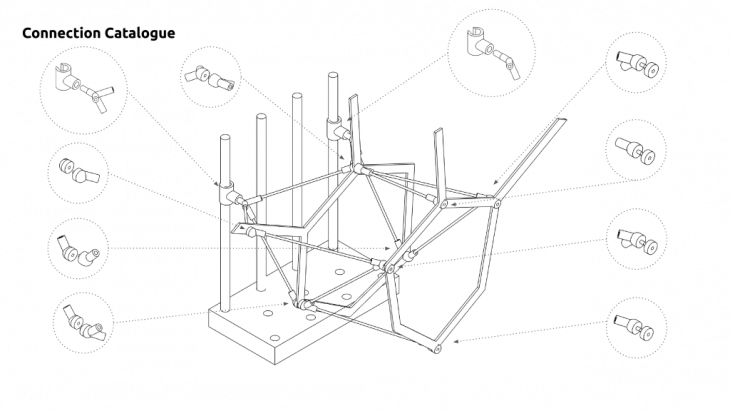
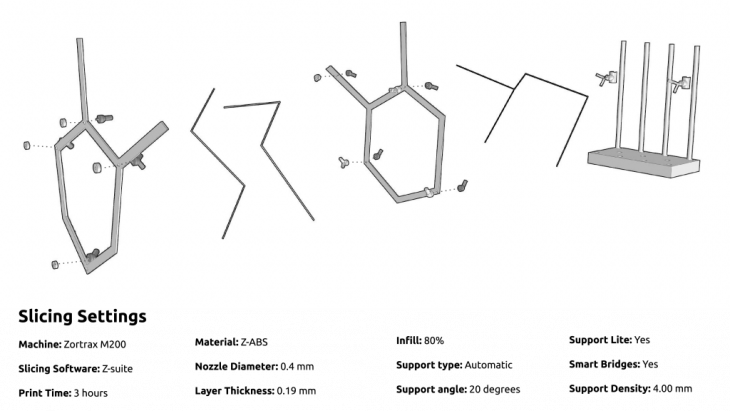
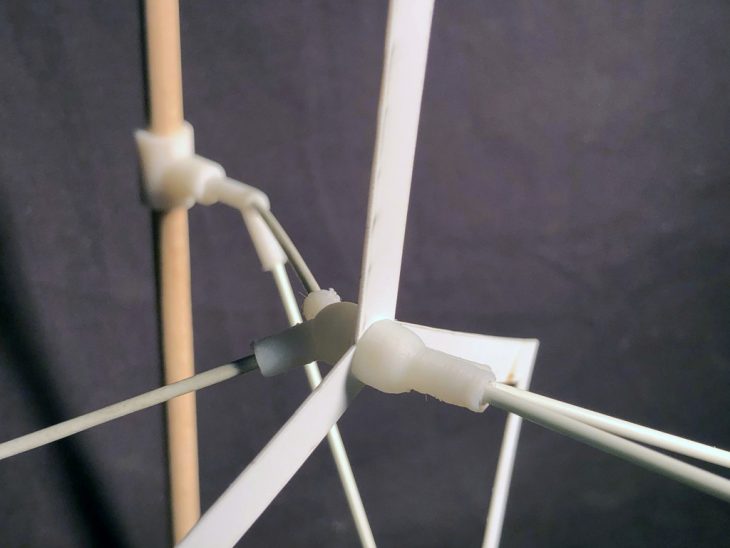
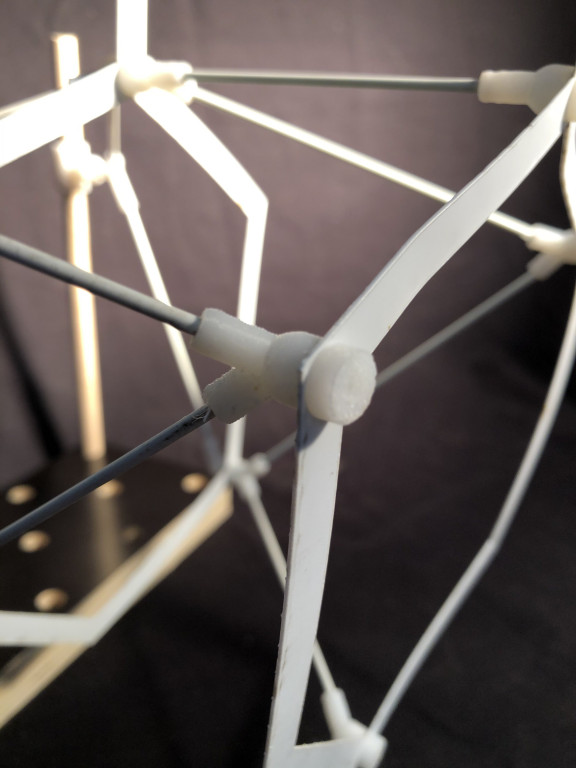
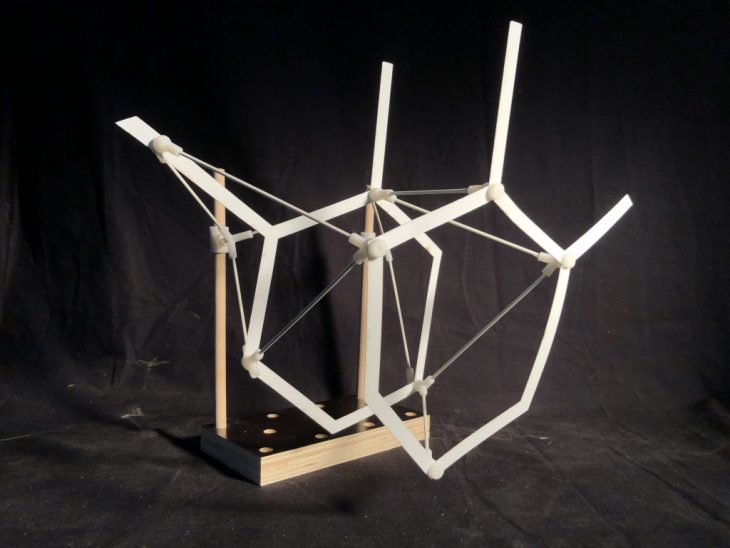
The Matrix_Kihoon

January 20th, 2008 kihoon.nam@iaac.net Posted in _Ki Hoon Nam | No Comments »

Click image for full view

muntitled-1.jpg

Click image for full view

AddThis Social Bookmark Button

the ripple

January 15th, 2008 dorota.kabala@iaac.net Posted in | PROJECTS: THE RIPPLE, _Ki Hoon Nam, _Dorota Kabala | No Comments »

we use 2 cuts: the rough cut and the final cut,

the pattern created by the rough cut we treat as a part of the final structure .

rough cut: Parallel Finishing

tool /ball mill, d=26mm/;  parameters /angle 90, distance=8mm/

final cut: Engraving

tool / flat mill, d=8mm/; parameters / total cut depth 5mm/

surfacemaly.jpg

AddThis Social Bookmark Button

FEEDBACK

January 3rd, 2008 francisca.aroso@iaac.net Posted in | FEEDBACK, _Francisca Aroso | No Comments »

     I would classify this course with average difficulty. The use of new software and machinery to develop real models was challenging and made it truly interesting, both in terms of the theoretical contents and especially the practical work. I sense that I’ve developed empirical knowledge that allows me to go deeper on this field. Learning state-of-the-art methods, high-tech machines and ultimate digital tools was crucial for me to acknowledge this area as my first choice for the 2nd term on the MAA. Also, the weekly high level of practice that this course required made us to develop self-sufficient work-skills, combining personal effort with the precious support from the docents, namely Marta Malé-Alemany, Shane Salisbury and Victor Viña, to which I extend my congratulations for being clear and practical. It’s important to underline that most of the knowledge gathered within this course was later used for the other courses of the MAA and therefore it justifies its inclusion on the 1st term. In addition, a constant change on the assignments and work groups was also very positive, because it allowed us to work with different fabrication processes and different colleagues and therefore to interact with different cultures and work methodologies. In general, the assignments were challenging and the major problems I’ve encountered were to manage the software and “operating” the machines in the proper way, with no mistakes. The existence of the blog was important for us to make contact with the work of all the different works made by all the students and also gave us the opportunity to improve and share our research with our colleagues.
      On the other hand, there are some aspects I think that remain to improve. Sometimes, during the period of time that we had to develop the assignments, there were no classes and it was very difficult for us to interact with the docents. Also, due to the interest of this course, I believe that it would be nice extend the number of classes.
      Bottom line, 5 stars course!

AddThis Social Bookmark Button

The ‘BAD’ Public Bath Equipment by Sabine Mueller and Andreas Quednau

December 27th, 2007 dorota.kabala@iaac.net Posted in | CASE-STUDY: CNC Milling, _Dorota Kabala | 1 Comment »

smaq-bath-copy.jpg

location: Solitude Palace Gardens, Stuttgart, Germany

materials: CNC-milled and oiled multiplex wooden board, ¾” garden hose, 38/5 mm transparent hose, brass fitting

total built-up area: 25 m2

net building cost: €20.000

date of commencement of project: 2004; date of completion of project: June 2006

all pictures taken from www.smaq.net ; more info at www.smaq.net and here

AddThis Social Bookmark Button

the “sitscape” by hackenbroich architekten

December 25th, 2007 dorota.kabala@iaac.net Posted in | CASE-STUDY: CNC Cutting, _Dorota Kabala | 1 Comment »

It is quite classical example of using digital cutting technologies to create a complicated form in fast and easy way. Unfortunately I am not sure if laminated wood pieces were cut by laser or milled.

Although I don’t like the form too much neither placing it in the room, I like that the construction is visible. What I like  a lot is that connecting some simple parts together designer creates a more complicated surface. I like the idea of combining many body positions in one piece of furniture. I am sure that it was so much easier to design it having the possibility of using the digital cutting process.

read and see more

sitscape_concept_01.jpg

sitscape_concept_02.jpg

sitscape_construction.jpg

sitscape_concept_03.jpg  sitscape_complete_door.jpg

sitscape_side_crowd.jpg

AddThis Social Bookmark Button

The matrix - Vasco Portugal

December 21st, 2007 vasco.portugal@iaac.net Posted in | PROJECTS: THE MATRIX, _Vasco Portugal | 1 Comment »

assgn2bconcept.jpgassgn2join1-copy.jpgassgn2join.jpg

AddThis Social Bookmark Button

December 20th, 2007 monica.szawiola@iaac.net Posted in | PROJECTS: THE RIPPLE, _Monika Szawiola, _Jordi Roses | 2 Comments »

opis1.jpgdone2.jpgthe effect -simple form showing intensity of the grid

The structure obtained by the horizontal roughing with a tool 26 mm, creatig feeling of two crossing surfaces

AddThis Social Bookmark Button

The Ripple_Mariana Paz + Rodrigo Langarica

December 19th, 2007 mariana.paz@iaac.net Posted in | PROJECTS: THE RIPPLE, _Rodrigo Avila, _Mariana Paz | No Comments »

We tried to create a surface that could give you the sensation of movement throughout a very simple pattern that would work in a three-dimensional way. By simplifying the work and using only one tool we managed to create a surface that has these characteristics but also can give you the sensation of a very complex geometry. We draw a curved pattern and then it was projected to the surface. The parallel finishing it was done only for having a smooth surface on the bottom after the engraving.

 lamina_00.jpg

Here are some images of the finished surface in Rhino.

lamina_01.jpg

The parameters that we used:

Tool: Flat mill 30mm diam

Horizontal Roughing

Intol: 0.1, Outol: 0.1, Stock: 0.6, Step over: 25%, Step down: 50%, Cut direction: climb, Cut pattern: Stock Offset

Parallel Finishing

Intol: 0.03, Outol: 0.03, Stock: 0, Stop over: 25%, Cut direction: mixed

Engraving

Tolerance: 0.03, Cut depth: 10, Rough depth: 10, Finish depth: 0

This work was not able to be finished due to the CNC Machine technical problems. 

AddThis Social Bookmark Button

the chip_

December 18th, 2007 agata.kycia@iaac.net Posted in _Michal Piasecki, _Stefania Sini, | PROJECTS: THE CHIP, _Maite Bravo, _Magda Osinska, _Agata Kycia, _Georgia Voudouri, _Advait Potnis | No Comments »

our chips were playing with movement as an input and light as an output, the creation process looked like this:

1blog1.jpg

finally constructed, 7 chips working…

2blog1.jpg

struggling with the interface :

3blog1.jpg

and the final piece, where depending on the movement the elements reacts by changing the speed of light blinking:

5blog1.jpg

6blog.jpg

video 1

video 2

photos on flickr

and the whole team:

4blog1.jpg

AddThis Social Bookmark Button

Case-Study_Electronics: Messa di Voce

December 18th, 2007 krzysztof.gornicki@iaac.net Posted in | CASE-STUDY: Electronics, _Krzysztof Gornicki | No Comments »

1blog.jpg

Messa di Voce is an audiovisual system in which the speech, shouts and songs produced by two vocalists are radically augmented in real-time by custom interactive visualization software. The installation touches on themes of abstract communication, synaesthetic relationships, cartoon language, and writing and scoring systems, within the context of a sophisticated and playful virtual world.

2blog.jpg

Levin and Lieberman’s software transforms every vocal nuance into correspondingly complex, subtly differentiated and highly expressive graphics. These visuals not only depict the users’ voices, but also serve as controls for their acoustic playback. While the voice-generated graphics thus become an instrument which the users can perform, body-based manipulations of these graphics additionally replay the sounds of the users’ voices — thus creating a cycle of interaction that fully integrates the visitors into an ambience consisting of sound, virtual objects and real-time processing.

3blog.jpg

Messa di Voce lies at an intersection of human and technological performance extremes, melding the unpredictable spontaneity of the unconstrained human voice with the latest in computer vision and speech analysis technologies. Utterly wordless, yet profoundly verbal, Messa di Voce is designed to provoke questions about the meaning and effects of speech sounds, speech acts, and the immersive environment of language. (all the text from messa di voce website)

4blog.jpg

Links to some movies:

http://www.tmema.org/messa/video/messa_ica1_jaapsolo_01s.mov

http://www.tmema.org/messa/video/messa_ica1_ripple_01s.mov

http://www.tmema.org/messa/video/messa_ica1_fluid_01s.mov

5blog.jpg

More interesting informations You can find on Messa di Voce website:

http://www.tmema.org/messa/messa.html

AddThis Social Bookmark Button

The Ripple

December 18th, 2007 alessio.carta@iaac.net Posted in _Alessio Carta | No Comments »

process-blog.jpg

This work was not able to be finished due the CNC machine technical problems

AddThis Social Bookmark Button

The ripple

December 18th, 2007 eduardo.mayo@iaac.net Posted in | PROJECTS: THE RIPPLE, _Ramon Velazquez, _Eduardo Mayo | No Comments »

final-01.jpg

These are the two 3d models that we generated in Rhino. The first one consist on a ”moon landscape” made by egraving and the second one pretends to recognise the shape of the preexisting suface by a group of lines that show its topology.

We decided to mil the second one because we thought that would take less time to do it. So on, next image talks about this process and the final result.

2a.jpg

AddThis Social Bookmark Button

The Chip

December 18th, 2007 rohan.khurana@iaac.net Posted in _Rodrigo Avila, _Rohan Khurana, | PROJECTS: THE CHIP, _Nazli Yucel, _Maria Eftychi, _Evangelia Vlacho Poulou, _Jordi Roses, _Dorota Kabala | No Comments »

fab.jpg

Our new assigment was to develop electronic panels with chips that is taking movement as input and light as output.

For this, we first developed our panels and decided on the behaviour of light (output). We programmed our microcontrollers as; taking movement as input and fastly blinking light 10 times,keeping the light for 10 seconds and decreasing amount of light slowly. After this,we designed little boxes having panels inside and one side covered with translucent material.

At the end, our idea come up with the result that when you move inside designated area, you can see that different boxes creating different effects on the floor/wall.

AddThis Social Bookmark Button

The Ripple_Evangelia Vlachopoulou+Krzysztof Gornicki

December 18th, 2007 krzysztof.gornicki@iaac.net Posted in | PROJECTS: THE RIPPLE, _Krzysztof Gornicki, _Evangelia Vlacho Poulou | No Comments »

2-blog.jpg

1-blog1.jpg

3-blog.jpg

AddThis Social Bookmark Button

The Ripple by Advait Potnis + Joe Peerapong Suntinanond

December 18th, 2007 peerapong.suntinanond@iaac.net Posted in | PROJECTS: THE RIPPLE, _Peerapong Suntinanond, _Advait Potnis | No Comments »

to-blog.jpg

AddThis Social Bookmark Button

Assignment 4_ The Chip

December 18th, 2007 pete.booth@iaac.net Posted in _Vagia Pantou, _Pete Booth, _Vasco Portugal, _Verena Vogler, | PROJECTS: THE CHIP, _Monika Szawiola, _Mariana Paz, _Eduardo Mayo, _Eugenio Adame, _Georgios Machairas, _Krzysztof Gornicki, _Alessio Carta | 1 Comment »

Our group was assigned rotational input and light output for our electronics assignment. In addition to this we also ended up with 11 people in our group somehow. We got off to a great start with the milling, and chip making, but eventually we had a few problems with the milling, resulting with a nice little groove cut into the bed of the machine (we already told Vicotor about this and it wasn’t our fault).

watch a movie of the final panel in action here at youtube


Krzys hard at work with the chip making.

We decided for the panel that it would be much nicer if the actual object that you controlled was the object that changed, so we devised a series of 8×8x8cm cubes that would contain the electronic components.

These 9 cubes were mounted on a large base board, allowing the sensor to be fixed and the cubes to rotate. Many long discussion were fought about the layout of the cubes, but ultimately we decided that a fairly regular pattern would suit the project better.

Upon completion we managed to have 7 cubes working perfectly, 1 that is constantly on and one that has now chip at all. In addition to the 5 chips that we managed to destroy during the production process somehow. Victor had a look at these and apparently they look perfect, but just won’t work.

The panel its self allows you to vary the rate at which the light blinks by the amount that you rotate the cubes.

AddThis Social Bookmark Button

the ripple_vagia pantou / nazli yucel

December 18th, 2007 vagia.pantou@iaac.net Posted in | PROJECTS: THE RIPPLE, _Vagia Pantou, _Nazli Yucel | No Comments »

assign-3.jpg

after the rough cut, the lines designed would be used as engravement paths.

this work was not able to be finished due to CNC machine technical problems.

AddThis Social Bookmark Button

Laser-Cut Art Book by Olafur Eliasson

December 18th, 2007 maria.papaloizou@iaac.net Posted in | CASE-STUDY: CNC Cutting, _Maria Papaloizou, _Anastasia Fragoudi | 1 Comment »

Artist Olafur Eliasson created this piece, a laser-cut negative space rendering of his house in 85:1 scale:

Your House

pic3.jpg  pic4.jpg

It’s made of 454 slices, bound together in a book. The process to put together, due to the complex constraints that were put upon the paper, was quite difficult.

215.jpg   51.jpg

The company that produced the book are a laser-cutting house that specializes in paper-cutting, called Visionen in Papier (Visions in Paper).

AddThis Social Bookmark Button

CNC Milling Operations

December 18th, 2007 rohan.khurana@iaac.net Posted in | CASE-STUDY: CNC Milling, _Rohan Khurana, _Uncategorized | 1 Comment »

Computer Numerical Control (CNC) Milling is the most common form of CNC. CNC mills can perform the functions of drilling and often turning. CNC Mills are classified according to the number of axes that they possess. Axes are labeled as x and y for horizontal movement, and z for vertical movement, as shown in this view of a manual mill table. A standard manual light-duty mill (such as a Bridgeport™) is typically assumed to have four axes:

  1. Table x.
  2. Table y.
  3. Table z.
  4. Milling Head z.

The number of axes of a milling machine is a common subject of casual “shop talk” and is often interpreted in varying ways. We present here what we have seen typically presented by manufacturers. A five-axis CNC milling machine has an extra axis in the form of a horizontal pivot for the milling head, as shown below. This allows extra flexibility for machining with the end mill at an angle with respect to the table. A six-axis CNC milling machine would have another horizontal pivot for the milling head, this time perpendicular to the fifth axis.
 
CNC milling machines are traditionally programmed using a set of commands known as G-codes. G-codes represent specific CNC functions in alphanumeric format.

mill.jpg

AddThis Social Bookmark Button

The chip: input light-output sound/group 3

December 18th, 2007 anastasia.fragoudi@iaac.net Posted in _Ramon Velazquez, _Renu Gupta, _Weiss Michael, | PROJECTS: THE CHIP, _Rafael Gutierrez, _Krystian Kwiecinski, _Asaduzzaman Rassel, _Higinio Llames, _Ismini Koronidi, _Anastasia Fragoudi | No Comments »

Creating an electronic circuit is something that requires a lot of patience and time. Our group was assigned to have an input light and output sound. We started our group assignment by attending the lecture of Victor Vina. Victor explained us the function of the electronic components and the process of assembling the chip.

We started out by milling the panel-base of the circuits using a CNC milling machine which received data from a computer software.

ch01s.jpg

ch03s.jpg

Then each one of us started assembling their own electronic circuit by putting together all the components starting from the little ones, for example the clock, the transformer, e.t.c., and moving on to the bigger ones, like the light-sensor, the speaker, e.t.c.

ch05s.jpg

ch07s.jpg

Then we had to test if these circuits could work and give us the result that we desired so we had to check each one of them in the computer software. Many of them didn’t work so we had to find out what the mistake was and either repair them or make new ones.

ch09s.jpg

Meanwhile we were also working on the design of the panels and trying to figure out how we could achieve an interesting installation result with the input and output that we had using the computer software.

The designing of the panels was an issue that concerned us a lot. Our initial thoughts were to construct 3-dimensional panels that could move around the space. But we didn’t want the panels to be autonomous and independent, they had to somehow form a single flexible structure. This is how we came up with the idea of creating triangular panels and join them together in order to form a single panel that could move around the space. In each one of the panels there is a circuit inside and depending on the way that the single panel is moving the amount of light changes. Out of this we generate a differentiation in the sound.

ch11s.jpg

ch13s.jpg

The programming of the input of light and the output of sound was another area that we were interested in. We programmed each one of the circuits to create different musical notes forming a musical scale according to the order that they would be placed inside the panels. Finally our installation depends on the movement of the single panel and the amount of light that falls on it creating each time a different sound output.

In the presentation we demonstrated the way the panels work. Using a flashlight and moving the panel around the space we displayed the different sounds that could be produced.
chf1s.jpg

chf2s1.jpg

chf3s.jpg

During the presentation we had the opportunity to use the panels of another group and see how the two panels interact with each other. The other group had input movement and output light so by putting them together we could see how the variation of the movement that effected the amount of light could eventually produce a differentiation of sound.

chf4s.jpg

chf5s.jpg

chf6s.jpg

AddThis Social Bookmark Button

case-study:CNC cutting_chair by Mathias Bengtsson

December 18th, 2007 francisca.aroso@iaac.net Posted in | CASE-STUDY: CNC Cutting, _Francisca Aroso | No Comments »

“If laser cutting is the new handcrafted, then Mathias Bengtsson is a master craftsman.”

Born in Copenhagen, Bengtsson studied furniture design at the Danish Design School then went on to study at The Art Centre College-Europe, and the Royal College of Art in London.

Mathias Bengtsson (London-based) modeled this chair in 3D on a computer.
He used precision lasers to automatically cut individual plywood slices, which were assembled to give this chair the appearance of sculpted sandstone. Organic shapes like this were not possible to create before the advent of this kind of 3D modeling technology.

Generated by machine, his designs look like they have been carved from centuries of exposure to the elements, but in reality it is the flexibility of laser cutting that allows Bengtsson to create organic forms out of materials that don’t normally lend themselves to manipulation.

Bengtsson uses materials that are both natural and manufactured, and some of his pieces are fashioned out of the unexpected like fire retardant foam that has to be water-cut and joined by tension rods for stability. Each material seems to be carefully chosen to highlight the sinuousness of the final design.

bengtsson_thumb.jpgbengtsson_1.jpgbengtsson_3.jpg

AddThis Social Bookmark Button

Assignment 3_ The Ripple_ Pete Booth + Maria Eftychi

December 18th, 2007 pete.booth@iaac.net Posted in | PROJECTS: THE RIPPLE, _Pete Booth, _Maria Eftychi | No Comments »

For our CNC milling assignment we based out design on mirrore, radiating curves.  This would provide a great variation between surface finished from one end of the piece to the other.  The detail below shows connection curves outside the material boundary, joining all of the line together in order to maximize milling efficiency.  To add further detail to the surface, one set of lines was elevated 1mm above the finished level while the opposing set were left directly on the finished level.


engraving lines and detail.


rough cut.

We reduced the rough cut levels in order to remove excess material as close to the finished surface as possible.  Even with these settings, flat sections are still visible.

Engraving cut.

The lines that we created in AutoCAD were used as engraving paths, in 2 continuous passes.

This work was not able to be finished due the CNC machine technical problems.

AddThis Social Bookmark Button

The Ripple_ Eugenio Adame/ Verena Vogler

December 18th, 2007 verena.vogler@iaac.net Posted in | PROJECTS: THE RIPPLE, _Verena Vogler, _Eugenio Adame | No Comments »

EXPERIMENTS WITH THE CNC MACHINE 

/project is finally milled ;)

the-ripple.JPG

the-ripple_2.JPG

AddThis Social Bookmark Button

The Ripple_Rohan Khurana+Georgios Machairas

December 18th, 2007 rohan.khurana@iaac.net Posted in | PROJECTS: THE RIPPLE, _Rohan Khurana, _Georgios Machairas | No Comments »

final1.jpg

The ‘imprint’ is the thumb impression on the ripple which evolves or explodes from a central focus point. It could also be compared to the electromagnetic pulse through a system.

Technical Details:

Tool : Ball Mill 12 mm dia

Rough Cut Parameters :

Stepover : 80 %

Stepdown : 25%

Cut Direction : Climb

Cut Pattern : Linear

Intol : 0.1

Outol : 0.1

Stock : 0.6

Engraving  Parameters :

Tolerence : 0.03

Cut Depth : 10

Rough Depth : 8

Finish Depth : 2

AddThis Social Bookmark Button

The Chip

December 18th, 2007 marcelo.riva@iaac.net Posted in _Peerapong Suntinanond, _Uday Goswam, _Gabriele Pileri, | PROJECTS: THE CHIP, _Marcelo Riva, _Javier Pittaluga, _Andrea Katsavra, _Francisca Aroso, _Hemant Purohit, _Akriti Sood | 1 Comment »

Phase 1
processa.jpg

Phase 1

process-b.jpg

AddThis Social Bookmark Button

Assignment 4 _The Chip

December 18th, 2007 bianny.poueriet@iaac.net Posted in _Luis Fernando Odiaga, _Maria Papaloizou, _Vikrant Sharma, | PROJECTS: THE CHIP, _Javier Raya, _Erik Thorson, _Ben Howard, _Bianny Poueriet, _Diego Camargo, _Alexander Harris | 2 Comments »

dscn2233-copy.JPG

The work of our group was to develop a structure managed by the Chips done in the FabLab in order to produce movement from a source of light.

The process of the design begun with the idea of having a kind of installation, but in order to make this more architectural we build up a composition of cubes, and with a diamond shape cut that could function as a solar window.

the-chip-copy.jpg

For this work, the software make the panels move at the time you block the light, or produce a shadow next to it. There is a video for the tests that we made with the work and pictures of all the process in order to make this happen.

lasercut-trial-copy.jpg

assembly-copy.jpg

CLICK HERE TO SEE THE VIDEO OF THE FINAL PRESENTATION.

AddThis Social Bookmark Button

Assignment 3_The Ripple_Akriti Sood, Uday R Goswami

December 18th, 2007 uday.goswam@iaac.net Posted in | PROJECTS: THE RIPPLE, _Uday Goswam, _Akriti Sood | 1 Comment »

The  milling process started with the Rough Cut but  was not able to be finished due the CNC machine technical problems.
upload-11.jpg

The intention behind this project was to create a series of diagonal curvilinear pattern all over the given undulating surface using CNC milling machine. It was intended to achieve through the following process.

1. Horizontal Roughing (Rough Cut)  with a set of parameter control

2. Horizontal Finishing with a set of parameter control

3. Curve Finishing with a set parameter control

AddThis Social Bookmark Button

FIZZLE- Installation at the Paul Gleason Theatre

December 17th, 2007 georgia.voudouri@iaac.net Posted in | CASE-STUDY: CNC Milling, _Georgia Voudouri | 1 Comment »

This installation was designed by post-professional M.ARCH2 students at UCLA for the Paul Gleason Theatre in Hollywood (California). The project consists of two parts; 2,54m x 2,15m x 1m, and 2,54m x 2,15m x 0,5m respectively and it took eighteen weeks to complete.

final 1final 2

The initial form was a minimal surface- one with a mean curvature of zero (see Frei Otto, or link)- forming a surface that was intended to be hung. Light was intended to be included as a reactionary devise to people’s movement. Eventually, after the necessary cutbacks, the two surfaces emerged from the wall with minimal disturbance to the existing structure. The light, produced by veins (white LEDs)were designed as to induce movement in people.

design

tests 2tests 1

firs hose

Because of the nature and complexity of the project, a conceptual part was the complementary process of physical and digital testing. Finally, polyurethane foam molds were milled to form the desired shapes. These were used to vacuum form PETG pieces that were laser trimmed by hand to extract the desired shapes. Of course, although the variety of final pieces produced was not satisfactory for the students, the cost of milling and vacuum forming inhibited them from doing exactly what they wanted. Also, the project included light, so some electronic components had to be tested, starting with a hose model and some diodes, so as to find some of the shadow tendencies with differing light orientations.

fizzle.jpg

http://www.archinect.com/schoolblog/entry.php?id=58665_0_39_0_C

AddThis Social Bookmark Button

Assignment 3_ the ripple_Georgios Machairas + Rohan Khurana

December 17th, 2007 georgios.machairas@iaac.net Posted in | PROJECTS: THE RIPPLE, _Rohan Khurana, _Georgios Machairas | 1 Comment »

This work was not able to be finished due the CNC machine technical problems

35.jpg

212.jpg

untitled-9.jpg

AddThis Social Bookmark Button

case-study: CNC milling

December 17th, 2007 francisca.aroso@iaac.net Posted in | CASE-STUDY: CNC Milling, _Francisca Aroso | 1 Comment »

milling-machine.jpg

“The design of this 4700 sq. ft. tenant improvement evolved from the unique challenge to remodel an early 1960’s Frank Gehry-designed commercial structure located in the heart of downtown Santa Monica into the stylish west coast branch of a full service post-production facility based out of Chicago. Three separate, soundproof video-editing bays were required, in addition to a conference room, an executive producer’s office, and lounge areas. Their specific programmatic and technological needs, combined with the good bones of Gehry’s original space, inspired lead designer Lawrence Scarpa’s vibrantly eclectic solution. His design engages the user, heightening their sense of awareness and bringing them a deeper understanding and vitality to their experience of the space.
In the treatment of the CoOP project, Pugh + Scarpa successfully incorporates the complex demands of a high-performance production studio with striking aesthetics that speak to the creative nature of the client’s work.”

Project Team
Pugh + Scarpa Architects (architect)
Gordon Polon (engineer)
Hinerfeld Ward Inc. (general contractor)
Marvin Rand (photography)

Awards
AIA National Honor Award, 2004
AIA California Council Award, 2004
AIA Los Angeles Design Award, 2003
AIA Los Angeles Special Decade Award, 2006
Record Interiors, 2003
Wood Design Awards, 2003

AddThis Social Bookmark Button

CNC fabrication at ETH Zurich.

December 17th, 2007 dorota.kabala@iaac.net Posted in | CASE-STUDY: CNC Cutting, _Dorota Kabala | 1 Comment »

Here are some examples of the assignment for postgraduate students at ETH Zurich (Swiss Federal Institute of Technology Zurich); the course Master of Advanced Studies in Architecture, Specialization in Computer Aided Architectural Design 2005/2006.

The assignment supervision: Oskar Zieta, Philipp Schaerer.

The exercise was to design the paravent using Trumatic 6000 laser-press-machine which both cut and bends material; while being limited to one material – structural plate steel (sheet 2000×1000mm, thickness 1mm ) . Some examples you can see below(1st by Arno Schlueter, 2nd by Bergit Hillner, 3rd by Oskar Zieta) the others here.

The pictures below show for each of  three paravents: sheet with the cut elements + drawing + photo

blog-oskar2-copy.jpg

AddThis Social Bookmark Button

Case Study: Electronics Eavesdripping

December 17th, 2007 marcelo.riva@iaac.net Posted in | CASE-STUDY: Electronics, _Marcelo Riva | 1 Comment »

watter-display.jpg

Eavesdripping is the design for an installation that uses water as both medium and display, rendering invisible communication visible.

To see the video click here its nice to see how it works

AddThis Social Bookmark Button

Case Study: Electronics SnOil

December 17th, 2007 marcelo.riva@iaac.net Posted in | CASE-STUDY: Electronics, _Marcelo Riva | No Comments »

snoil.jpg

SnOil makes use of the ferrofluids magnetic sensitivity to selectively position and shape the fluid. This is done by electromagnets, which enable the appearing and disappearing of a magnetic field by switching the flow of an electric current. Therefore SnOil consists of two main parts: An approx. 25 by 25 cm sized basin that is filled with ferrofluid up to a height of a few millimeters. Directly underneath there is a grid of 144 (12 by 12) electromagnets that are arranged closely to each other. The magnets are arranged in four structurally identical blocks with 36 pieces each. The electronics for triggering the separate magnets are located on several layers of printed circuit boards directly underneath the layer of magnets. This makes the system highly scaleable in size and its footprint.

To understand better the way it was built and how it works watch this video is really cool!!

AddThis Social Bookmark Button

Case Study: Electronics Aperture

December 17th, 2007 marcelo.riva@iaac.net Posted in | CASE-STUDY: Electronics, _Marcelo Riva | 1 Comment »

aaperture.jpg

aperture is a facade installation with interactive and narrative displaying modes. Consisting of an iris diaphragm matrix, the facade’s surface with its apertures’ variable opening diameters is enriched by a dynamic translucency, that creates new imagery as well as a new channel for communication between inside and outside

Videos Site and Images of this project

AddThis Social Bookmark Button

m.any

December 17th, 2007 pete.booth@iaac.net Posted in | CASE-STUDY: CNC Cutting, _Pete Booth | 1 Comment »

Based upon 3-dimensional “cellular automata”, m.any displays the concept and prototypical realization of a complete digital work flow from parametric design to production on CNC-machines. An irregular spatial structure generated by algorithms was controlled and manipulated through an especially developed software. In addition to the calculation of the complex geometry, the software also generated necessary parametrical construction elements for the realization.


java generation of form

A masters project for a group of postgraduate students of Computer Aided Design (CAAD) at ETH Zurich, Switzerland, m.any was realized during a three month period. Intertwined with the programming process, construction studies and fabrication systems were developed. Using construction data directly derived from the 3D-model, m.any variations could be explored and tested. Using a combination of JAVA and RhinoScript, the group were able to generate, test and prototype the design process ensuring that it met the assessment criteria. 3D printed models were created during initial visualizations, followed by laser-cut, component based models.

rhino3d generation and 3d printer tests.

The final and realized spatial structure consists out of 1500 individual parts all generated and produced in a seamless digital workflow. 111 main assembly frames were CNC milled, and precisely 1368 MDF connection pieces were laser-cut. In total 34 hours were spent in the workshop cutting all of the pieces, in addition to 16 hours of installation and construction time within the gallery.


rhino3d layout of cutting paths.

fabrication and assembly

The project represents a quite remarkable fusion of two different CNC techniques, highlighting the different capacities of each of the two machines.

AddThis Social Bookmark Button

the application of rapid prototyping technics in surgery

December 17th, 2007 anastasia.fragoudi@iaac.net Posted in | CASE-STUDY: Rapid Prototyping, _Higinio Llames, _Anastasia Fragoudi | 1 Comment »

The advances in digital technologies brought upon a kind of “revolution” in the field of architecture and design. The new abilities that they offer give the opportunity to designers, artists and architects to realize concepts and projects that only existed in the sphere of the virtual, of the inconceivable. Although another question rises: Can these technologies be useful for the common good? Can they save human lives? Through the advances in digital technologies the surgeons are now able to create 3d physical models from CT (Computed Tomography) and MRI (Magnetic Resonance Imaging). Through specific computer softwares surgeons can develop accurate 3d digital models isolating the problematic areas. The next step is to create 3d physical models by using a 3d printer or a rapid prototyping machine. In this way the surgeons are able to perform “mock” surgeries prior to ever entering the operating room. Some surgeons find that minutes or hours of operating time can be saved by careful preparation using the models.

211.jpg

In the link below you can find more information about the use of rapid prototyping technics in surgery

http://ablesw.com/3d-doctor/

AddThis Social Bookmark Button

hidden.mgx vase by dan yeffet for materialise

December 17th, 2007 stefania.sini@iaac.net Posted in | CASE-STUDY: Rapid Prototyping | No Comments »

example.jpg

tecnology: SLS (Selective Laser Sintering)

material: polyamide (nylon)

hidden.mgx’ designed by dan yeffet for materialise in 2006.

comprised of polyamide nylon, ‘hidden’ is yet another of materialise’s odd, complex and utterly unique designs. at it’s heart, ‘hidden’ is a decorative vase with an exterior that seems to have been inspired either by barren tree branches in winter or one too many late night sci-fi/horror movies – kind of hard to tell.

but with just a little imagination the possibilities begin to become more clear , not only can you place flowers in the center of the object, but you could easily weave a variety of plants or other decorations through it’s ‘branches’, creating your own unique decoration or centerpiece that you can change and adapt to any time of year.

as with all materialise products, ‘hidden’ was created via ‘rapid prototyping technology’. this 3D material printing process allows for freedom of design far beyond the capacity of traditional manufacturing processes, literally building the object one tiny piece at a time.

AddThis Social Bookmark Button

Rip Curl Canyon

December 17th, 2007 pete.booth@iaac.net Posted in | CASE-STUDY: CNC Milling, | CASE-STUDY: CNC Cutting, _Pete Booth | 1 Comment »

The Rip Curl Canyon, by Benjamin Ball and Gaston Nogues, consists of around 4000 sheets of cardboa