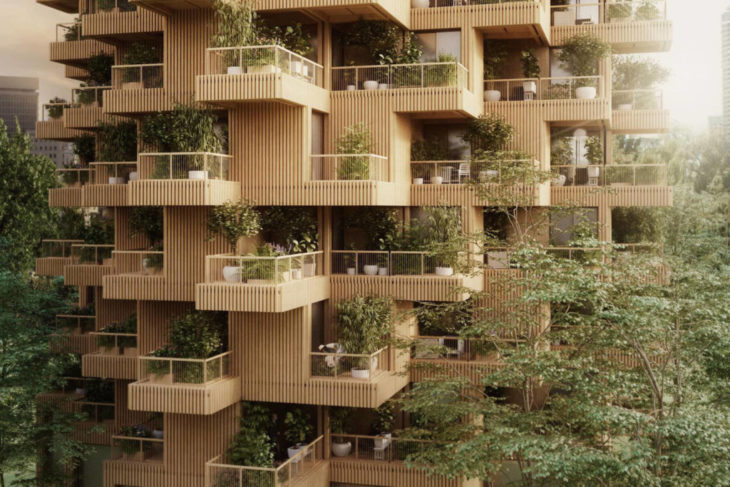
Source: Patrick Spencer Grove
Abstract
The built environment has a crucial role to play in terms of the wellbeing of our planet and our own species. Human beings spend approximately 87% of their lives inside buildings (NHAPS, 2001) and in countries like USA buildings account for roughly 40% of the total energy use (US Dep. of Energy, 2017). Among other reasons, this is why building performance is an essential aspect to consider in the process of building design.
Performance design includes aspects such as energy use, passive design, thermal properties and embedded energy, amongst other features. Understanding how these variables interact in a built environment project is not only valuable but also necessary in today’s fast-paced industry.
The objective of this module is to introduce students to the world of environmental performance in the built environment and to provide them with the essential knowledge and tools regarding the functioning and technical performance of mass timber buildings. This is achieved via a combination of theoretical lectures and the implementation of live in-class practical exercises using different tools.
Faculty
Patrick Spencer Grove is an environmental design and engineering consultant with a great commitment to sustainability. Motivated by the preservation of the environment, he is dedicated to solving environmental issues from a consulting and educational approach. He has participated in the evaluation and supervision of MBA consulting projects, as reviewer of bachelor’s degree thesis projects and as technical advisor for Solar Decathlon competitions. He has 8 years of experience in the private consulting sector, having participated in the technical development of residential, office, commercial, cultural and healthcare projects. He has knowledge and experience in the topics of passive design, energy use, thermal performance, lighting and building simulation modeling, among other performance-related built environment aspects. Patrick holds a Master’s degree in Architecture & Energy Efficiency from Universidad Andrés Bello and a Master’s in Environmental Design and Engineering from University College London.