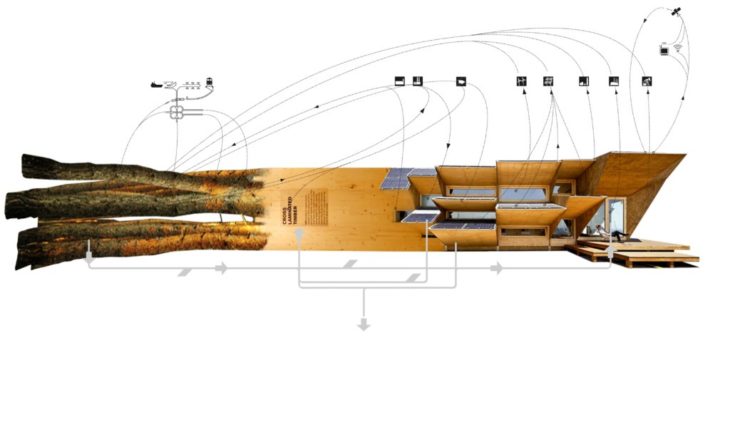
Credits: IAAC, Daniel Ibanez
Abstract
The environmental challenges of this century demand a new generation of buildings made from renewable, reusable, and carbon-storing materials; timber is uniquely positioned to address this challenge. Recent technological developments enable tall building structures made with prefabricated and highly industrialized mass timber elements. Educating a new generation of architects, engineers, and designers in ecological design and building practices is therefore of critical importance for contemporary society, and promotes the expertise necessary to make the most of new technical opportunities. The construction sector is gradually shifting toward prefabrication, industrialization, and off-site manufacturing as these strategies shorten construction time, reduce embedded energy expenditures, reduce CO2 emissions, and reduce waste generation. This shift requires greater design control and increased manufacturing precision, thus positioning architects, engineers, and designers as key actors. This paradigm shift requires students to learn the key ecological, technological, and technical aspects of mass timber design in order to innovate and emerge as the leading professionals our world requires. In this context, this course explores the state of the art of these debates through a series of key readings. Structured around a series of key topics, this course interrogates if mass timber design is… carbon storing, industrialized, forest friendly, thermal, structural, assemblable, machinable, urbanism? This series of questions would enable students to cover some of the basic aspects that are positioning mass timber design at the forefront of sustainable debates about the built environment.
Faculty
Daniel Ibañez MArch, MAA, MDes, DDes is a Spanish practicing architect and urbanist based in Cambridge, Massachusetts, USA. He is Doctor of Design from Harvard GSD, Director of the Master in Mass Timber Design, co-Director of the Master in Advanced Ecological Buildings and Biocities at the Institute for Advanced Architecture of Cataluya (IAAC) and member of the Urban Theory Lab. Daniel is specialized in ecological urbanism and architecture, in particular how to frame the design disciplines in relation to broader socio-ecological interdependencies. He is author/editor of Wood Urbanism: From Molecular to Territorial (Actar, 2019) and author of ecological timber projects including the Fab Lab House (Madrid, 2010), Endesa Pavilion (Oslo, 2013), the Endesa World Fab Condenser (Barcelona, 2014), or prototypes such as the Tiny House and the Voxel (Barcelona, 2019-2020). Since 2018, he serves as senior consultant for the World Bank advising governments and international institutions on ecological urban and architectural developments.