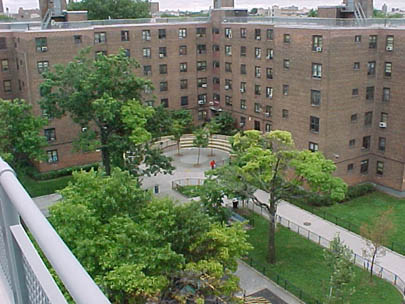
Marcy Subsidized Housing Projects, Brooklyn, New York [Source: brooklyn.com]
This model of public housing encompassing public space effectively suppresses the identities of inhabitants down to bleak facades hiding unsuitable and often dangerous open space.
There’s something imaginatively attractive about abandoned parks, streets, and buildings. Void of life, they still exist, quietly telling us of an opportunity to design better. But for the people – those that were suppose to use the community park with no streetlights, or the narrow alleyways leading to dead-ends, or live and work in the poorly designed buildings of poorly planned districts – these abandoned elements of community become a threat to the neighborhood’s economic attractiveness and secure functionality.
The Value of Identity In a rather crude synopsis, I am a 25 yr old, middle-class, Trinidadian-American, black-female, architectural designer from New York City. I am heavily influenced by my residencies back and forth between the city and my suburban home in Maryland, as well as experiences in iconic cities nationally and internationally. Passion drives my research into the positive impact that sustainable and interdisciplinary design methods and technologies can potentially have on disheartening urban realities. After graduate research, I intend to find my places alongside architects, engineers, socio-economists, planners, material researchers, developers and scientists in interdisciplinary work. You see, in contrast to the abandoned city park, I exist, full of life, loudly speaking on hopeful opportunities to design better. Architects often neglect the value in designing for the individual seeking identity and instead cater to a communal ideal; But, what is a community without the individual identities? It’s much like a designing a home for no one. By no means am I claiming to already have all the answers; I do, however, recognize the importance of communal and therefore individual identity, in the challenges that architecture and urban design ought to face.
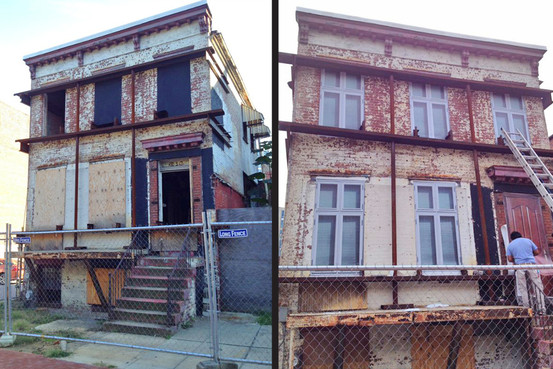
Mock Window on Vacant Building in Washington, D.C., before and after decals by Home Illusions. Douglas Development
Architecture shouldn’t veer away from the social promotion of self-esteem and pride in one’s community. In New York, Baltimore, Washington D.C. and many other cities across the states, there are initiatives for painting mock windows and doors onto boarded up houses. These temporary facade upgrades are very basic but are decent examples of how the appearance affects function within a community scale. There are studies addressing the domino effect of such simple beautification mechanisms tackling blight because they prove to abate issues of security, vandalism, and declining property values. In addition, this $40 – $100 effort over the life of the project is minimal for city housing departments compared to the high cost of maintaining or demolishing the buildings. Whether designed with the intention to overcome these challenges, or designed oblivious to them, Architecture is an active component to either a better or worse outcome for the urban environment. Think of the last time you had something to toss while in a really beautiful place. Would you throw it on the ground because it made you feel better to be rid of it, rather than considering the value of the better option? No. But if you found yourself in a place that is already a mess, what is the opportunity cost of choosing to lighten your load instead of being meticulous in an already undervalued place? If people, especially children that replicate what they see, feel that their situation is hopeless, there is less incentive to do the right thing; This is even more true in abandoned public areas with no one to hold you accountable.
The Repercussions of Operating in the Dark Walking under eerie overpasses, down lifeless streets in rundown industrial neighborhoods, after the shops have closed and the sun has set, would likely instill heightened uneasiness in any passerby. The situation becomes substantially worse when the overpass is the home to the homeless, the industrial neighborhood doubles as informal residence to criminal activity, the local shop owners can’t afford to keep shops open, and the uneasiness of the passerby is the insecurity residents live day to day. South Bronx, New York of the 1950’s-70’s, is arguably one of urban America’s most notable examples of the nightmare associated with urban decay. The 1950’s development of Robert Moses’s Cross-Bronx Expressway, considered a large-scale planning failure, is often blamed for the displacement of tens of thousands of middle-class residents, transforming the once active neighborhood into a slum. However, most people acknowledge politics as the overarching guilty party in governing the decay of South Bronx, though the intentions seemed relatively creditable. Regulations of the 1960’s to bus children in for mixed schools faced racial disparities that led to increased vacancies. Additional government policies for rent control surfaced after concentrating the poorest migrants to the diminishing edifices. This discouraged landlords from property maintenance and added to the vacancies. And from there the chaos escalated gravely:
… the Bronx began to burn in about 1970. Some of the fires were accidents, the inevitable result of decaying electrical systems. Many were set by landlords who would then collect the insurance money. Often they would sell the building–whether it was still inhabited or not–to “finishers” who would strip out the electrical wiring, plumbing fixtures, and anything else that could be sold for a profit before torching it. “Sometimes there’d be a note delivered telling you the place would burn that night,” one man who lived through the period told me. “Sometimes not.” People got used to sleeping with their shoes on, so that they could escape if the building began to burn. [Source:
http://www.washingtonmonthly.com/features/1999/9904.worth.bronx.html]
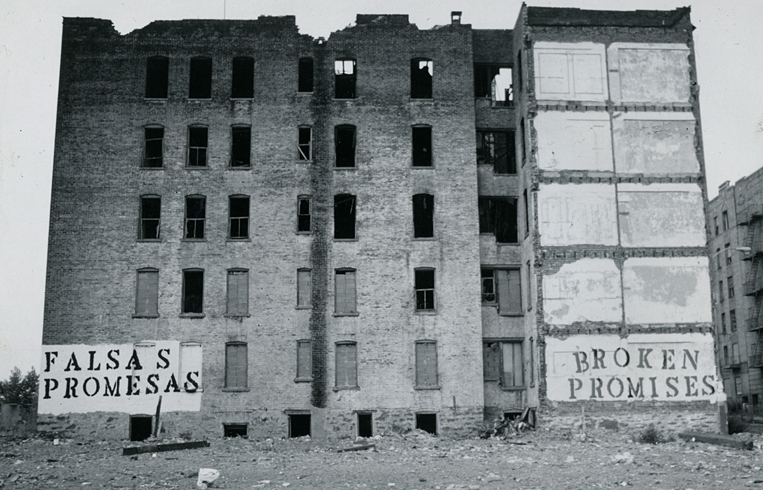
Photographer: John Fekner, 1980. Charlotte St. South, Bronx NY
Today, the local economy has picked back up substantially with the influx of planning, architecture and consumers. Urban reformation of vacant buildings and communal amenities positively correspond with the functionality of a neighborhood. And thus, these drivers should continue to evolve in unified forethought toward urban design not solely a scattered afterthought to save broken communities. The bottom line is capital. Wealthier neighborhoods invite a richer population, contrasting to middle and low income communities that progressively become unsafe. If these communities remain reliant on the wealthy to save them, unfortunately, they will continue to die out. Architecture is unequipped to tackle this challenge alone, hence the the hesitance to consider social issues as integral, often categorizing them as public works charity. The role of the architect does, however, have the capacity to gather economists, scientists, and engineers in a collective design process. Together with other applicable industries, there is potential for a cost effective solution to target the division of classes and promote diversity by supporting ministries and associations of housing, education, and public health with economical architectural alternatives.
Potential Affordability of Green Technology Technological systems seem to exist exponentially in what is being referred to as our first technological revolution. Almost everyday we can be made aware of a new start-up using the internet as a platform to share information in, literally, a click of a button. Architecture is said to be able to change with the times but the times are changing much more rapidly and meanwhile architecture is dancing along the outskirts, still trying to decide if it should or can jump in. It should. It can! By expanding its role to incorporate cost effective technology and material, an advanced interdisciplinary architecture can develop a framework for the design of safer urban communities. Generally speaking, architectural technological devices, such as the typically applied solar panels and wind turbines, come onto the market at a fairly high cost; Certainly, they are not immediately feasible for large-scale urban revitalization. However, over time, the cost of such devices decrease substantially due to competition and ease of production. Granted some systems may remain out of budget, but there is higher probability for more affordable options when there are more options in general. Presently, it takes much less time for a new solution to become a widely used, and therefore a much more affordable one because new technologies are being generated and shared so quickly. The internet and its open source paradigm is shared all around the world. Having internet access has become a primary priority as an educational resource and hub for social interaction. It is so heavily intertwined in our present day lives and is dynamic enough to transition into our future. Similarly, the primary elements of nature have proven timeless and increasingly effective in terms of generating power from water, solar, wind, soil, etc. I find it compelling to look at these basic elements in the same light alongside advanced technologies because it defies the bounds of time – primitive versus futuristic – yet they work so well together. The most appealing assets of both the internet and natural power is decisively its widespread accessibility, affordability (sometimes they are even free) and ability to customize functions. I believe there is some connection to discover in the exploration of sharing via network and applying natural systems for an economical architectural alternatives. Of course, transitioning to a macro-scale analysis of this brewing idea, there remains the issue of gentrification. However, natural systems hint at modest opportunities to be self-sufficient in communities that need local solutions, not grandeur political schemes in favor of the highest bidder or big corporations. So although the solution itself may not yet be clearly defined, its potential to respond to the effects of urban decay, is enough to warrant further research.
