A city is like an organism -it is living- it metabolizes our activities, grows, responds to changes, transforms, and may even degenerate. All these terms are assigned to describe very specific urban phenomena strongly suggesting that a city must be perceived as an organic whole: i.e. greater than the sum of its parts. Therefore, architects must bear in mind that any intervention done on the city, regardless of scale, must add to its wholeness and not contribute to its fragmentation. After all, the city is a mesh of nodes within a network, and a city’s success is determined by how well these connections work and account for the overall development. Hence, proper city planning has a major role to play in the overall wellbeing of cities. A building, on the other hand, is in fact the main constituent of the city and each building has the responsibility to contribute to a better urban life. It must develop symbiotic relationships within its context as well be flexible enough to stage new modes of appropriation that allow for new social and economic patterns to emerge. It is unquestionable that buildings as nodes and generators of activity and flow of people, money and culture, are tightly related to and inform the city infrastructure and must certainly feed into the transit system in coherent and harmonious ways; Unfortunately, this is not always the case. The city most often than not (in the absence of good planning) suffers the consequences of the greed of apathetic developers who tend, with their constructions, to surpass the capacity of existing infrastructure which in turn leads to serious problems such as traffic, congestion, pollution, mal servicing, financial losses, etc… The problem with this kind of profitability is the desire for fast cash. In an attempt to make fast and big money, developers disregard long term social and global benefits that may delay a project or compromise its financial profit- a highly undesirable option. Instead, building higher, optimizing the exploitation factor and maximizing profit at the expense of quality of life seem to predominate. Fortunately today, in contemporary architectural practices and theory, we witness a return to nature through biomimicry. This interdisciplinary approach to design opts to adapt lessons from nature towards more sustainable living practices. Then again, even when we come this close to responding to the real essential needs of human life on earth, we seem to fail, falling in the trap of aesthetic gratification, conceiving ridiculously expensive complex forms facilitated by accessible computer technologies, rather than truly engaging with natural processes and adapting them to our designs: This is what has been going on in the architectural world for the past few years up till today: Out of scale, organic looking buildings of ridiculous budgets that do not even respect context have been carried out by world known and avant garde architectural offices that claim to have a biological approach to their designs. Question is: Can we keep building such structures? Do we afford it on a global scale? I believe not. Appraisal has already begun in different parts and cultures of the world against buildings such as Tokyo 2020 Olympics stadium designed by Zaha Hadid architects for example.
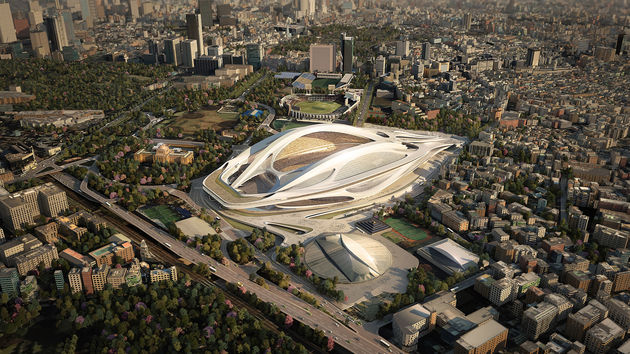
Mind v/s Heart??
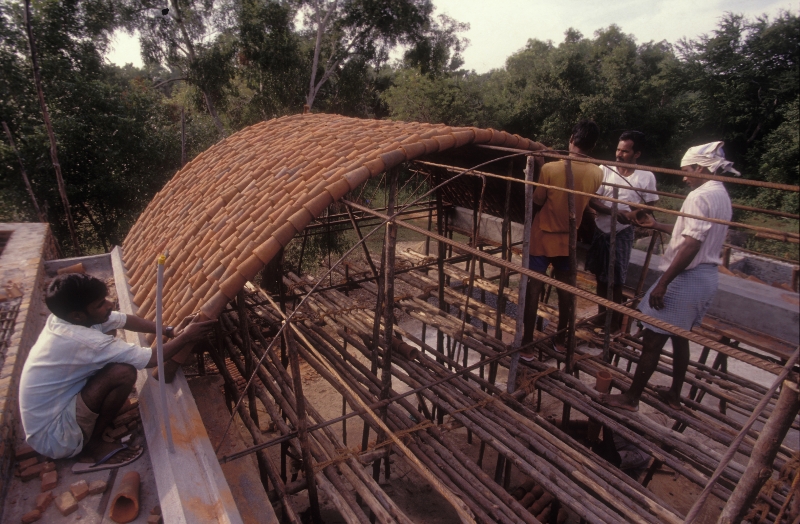
Mind v/s Heart??
In fact, what biomimicry suggests, are lessons in nature on how to build efficient structures, optimize the use of materials, how to sustain growth through zero waster systems, how to produce energy and manufacture our own materials to name a few. Learning lessons from nature on sustainable development ensures a cycle of activity and continuity which in turn ensures a continuous opportunity for financial profit.