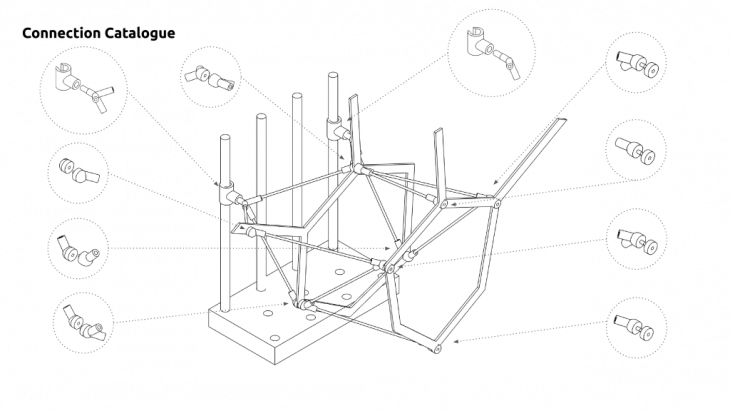
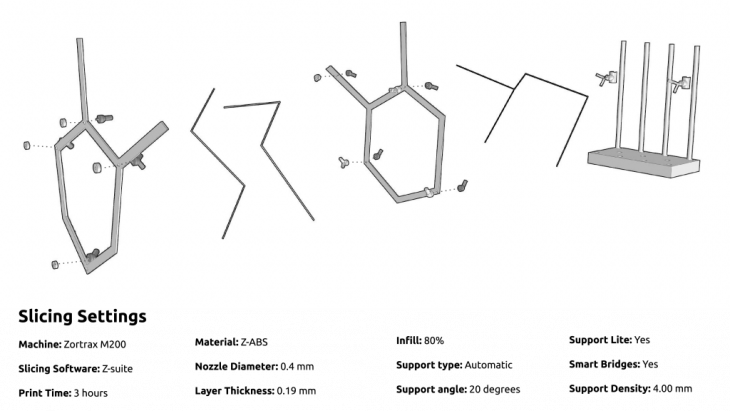
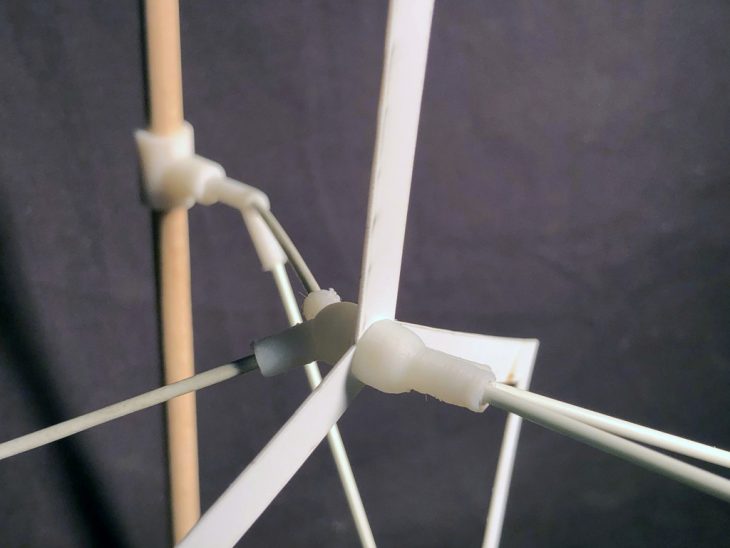
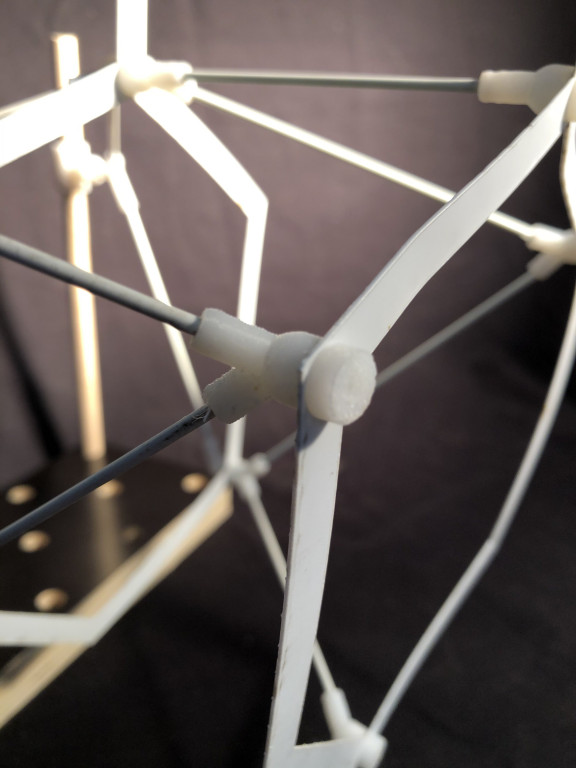
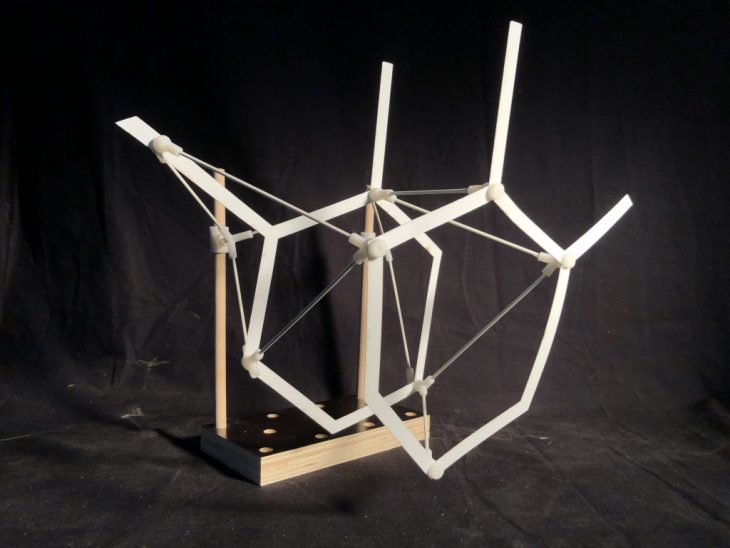
Radiolaria network

January 10th, 2010 moises.gamus@iaac.net Posted in Moises Gamus Duek | No Comments »

A very clear and succesful example of digital fabrication processed and controlled.

http://www.radiolaria-project.de/indexFlash.html

AddThis Social Bookmark Button

Studio 63 – Dex Showroom

January 5th, 2010 asim.hameed@iaac.net Posted in Asim Hameed, _Case Study_Tech 1: Subtractive 2D | No Comments »

DEX Showroom designed by Italy-based firm Studio 63 architecture and design. The project maintains its reputation due to the facade design that appears like a pixelized picture of the trees, filtering the natural and indoor lighting between inside and outside, creating a dramatic screen along the street.

Project: DEX Showroom

Location: Florence, Italy

Area: 360 Sqm

A row of trees that run along the plot became the inspiration for the design team creating architecture that engaged with its context, softly taking place in it but being at same time strongly characterized.

The facade is the assembly of 270 laser-cut metal frames painted white – which holes change in dimensions and distances – the skin of the building appears like a pixelized picture of the trees that are in front of it. This kind of metalwork allows the façade to change its aspect according to the change of the external daylight as well as of the night inner light. In this way the skin becomes sort of theatrical flat that mediate the relationship between the outside and the inside.

case study copy

AddThis Social Bookmark Button

Steven Holl Architects – Porosity Project

January 5th, 2010 asim.hameed@iaac.net Posted in Asim Hameed, _Case Study_Tech 3: Subtractive 3D | No Comments »

Steven Holl Architects wanted to do experiments in porosity and decided to take on the Porosity project. Random porosity involves a non-linear repetition of individual components in varying scales, while recursive porosity employs mathematical strategies to generate infinitely complex patterns.

Name: Porosity

Program: experiments in porosity

Size: 50 m2

Material: Developed in collaboration with Albefex Srl. of Treviso, Italy, the composite “Albeflex BL Special” is designed to be lightweight, self-supporting and capable of taking advantage of CNC driven digital fabrication techniques. Formed of cross-laminated plies of wood veneer and a central core of a proprietary new fabric and paper composite with a total thickness of 1.8 mm in four laminae, Albeflex has significantly less mass than similar materials based on sheet metal core materials. In addition, second stage fabrication associated with metal cores such as on a press brake, is eliminated as the hinge formed by the laser or water-jet scoring of the wood plies is flexible enough to allow for flat shipping and bending in the field.

Assembly: Three dimensional forms are digitally resolved into flat panels which are then automatically nested for maximally efficient use of the basic sheet size of 3050mm x 1050 mm. Individual panels, which are numbered and sequenced during the CNC fabrication process, thus eliminating the need for traditional shop or assembly drawing, are fabricated with 75mm scored border flaps. Folding and through-bolting of these flanges forms an autonomous diaphragm structure which provides rigidity through the interconnection of all elements.

Random and Recursive Porosity: Five experimental porous patterns are laser cut form the material, each exploring a particular aspect of the non-repetitive made possible by digital fabrication. Random porosity involves a non-linear repetition of individual components in varying scales, while recursive porosity employs mathematical strategies to generate infinitely complex patterns. In one experiment, Pascal’s Theorem is used as a generator for a porous cloud of hexagon-derived openings. The random and non-repetitive character of the experiment gives rise to a limitless range of rich and unexpected spatial phenomena.

porosity project

AddThis Social Bookmark Button

freshfibre_iPhonecover_FOC

December 22nd, 2009 tamara.obradovic@iaac.net Posted in Tamara Obradovic, _Case Study_Tech 2: Additive | No Comments »

Freedom of Creation have been exploring the field of 3D printing for over a decade. They believe that one of the promsing technologies that will bring losts of new opportunities to 3D printing is printing in paper.

They are one of the first to print a FreshFibre iphone cover using the matrix 300 printer. The printer was developed by MCOR who have been exploring the technology of several years.  ’For the first time the layering effext of 3D printing is actually adding value to the finish and look and feel of the product’. They slipped in a stack of rainbow-coloured paper into the MCOR’s input hopper, resulting in the the multicoloured iPhone cover. With paper printing, the object can be coloured before it’s even made.  What is intriguing about printing in paper is that the process itself is fairly simple, its about stacking layers of paper and removing what you don’t need.

It’s the greenest and most low-cost technology for 3D printing, therefore Freedom Of Creations’ Imagineering department is researching possible applications ranging from collection products to scale models and promotional material for clients.

0_MCOR-FRESH-FIBER2

MCOR-FRESH-FIBER

Using the same technology the chair  ”Little Albert” by Ron Arad, Moroso and printed for Hector Serrano was printed with commonly available office paper stock.

0_MCOR 300 chair

The Marix 300’s specifications:

  • Build chamber: 27.7 x 19.0 x 15.0 cm (10.9 x 7.5 x 5.9 inches)
  • System weight: 160 kg (350 pounds)
  • Material: A4 paper, 80 grams
  • Z-Axis thickness: 0.1mm
  • Power: 240 volts, 1 kilowatt

The Matrix 300 comes with proprietary software for using existing .STL files

All that with operating costs of less than one euro cent (or maybe just over a US cent) per cubic centimetre of printout.

As a highly cost effective and rapid manufacturing technique that uses renewable resources, this technology clearly opens us doors for further exploration and the development of larger format machines that have the potential to take on larger scale applications in architecture and urban design.

AddThis Social Bookmark Button

‘Softshelf’ by Softrigid

December 21st, 2009 ekaterina.ageeva@iaac.net Posted in Ekaterina Ageeva, _Case Study_Tech 3: Subtractive 3D | No Comments »

Softshelf is a shelving system which aims to shed the conventional rigid form of book shelves. The design is completely customized by the user who chooses the over size of the unit, size and shape of the individual blocks and the curvature of unit. Using CNC technology each shelf can be digitally customized and then built to the specifications. This malleable design system is what gives the shelf its ‘soft’ characteristics.

Безимени-12

AddThis Social Bookmark Button

3D Subtractive Case study_Greg Lynn_Recycled Toy Furniture

December 20th, 2009 joao.palaio@iaac.net Posted in Joao Nuno Palaio Albuquerque, _Case Study_Tech 3: Subtractive 3D | No Comments »

Series of furniture made from recycled children’s toys.

Picture 2 copy

PROCESS_The objects we’re scanned, remodeled to be assembled together and milled in a 5 axis milling machine in order to generate the notching and fitting areas among the multiple toys.

scan

toy

Untitled-1

Recycling toys into building elements, furniture and objects of use was the inspiration for the Recycled Toy Furniture.

img_2968b_sq

img_2964

AddThis Social Bookmark Button

Additve case study _ Emmanuel LATTES

December 20th, 2009 joao.palaio@iaac.net Posted in Joao Nuno Palaio Albuquerque, _Case Study_Tech 2: Additive | No Comments »

3D prints / sculptures by the artist Emmanuel LATTES, exploring mathematical geometries into 3dimensional softwares and the translation to materiality through 3dprinting.

Sculpture moderne représentant deux rubans de Möbius imbriqués.

3640236117_d7b187c430

3640235719_c97d340a8d

Sculpture moderne représentant deux rubans de Möbius imbriqués.

AddThis Social Bookmark Button

Zaha Hadid Cirrus

December 13th, 2009 eleni.kolovou@iaac.net Posted in Eleni Kolovou, _Case Study_Tech 1: Subtractive 2D | No Comments »

zha_01

PROGRAM:
Furniture made from Formica® to be sold at auction benefiting the the CAC’s exhibitions and education programs
CLIENT:
Lois & Richard Rosenthal Center for Contemporary Art, Cincinnati
MATERIALS:
Laminate by Formica®, color Black (909-90) in Polished finish, stained medium density fiberboard
SIZE:
96 x 96 x 96 in

zha_02

CONCEPT:
Zaha Hadid Architects design Cirrus was produced in collaboration with the Contemporary Arts Center and Formica Corporation. This dynamic sculpture was displayed as a part of the exhibition FORM: Contemporary Architects at Play, in Cincinnati in May 2008. A live auction will took place at which this exclusive first edition of Cirrus was sold. All proceeds from the auction went to benefit the CAC’s exhibitions and education programs.
Completed in 2003, 2008 year marks the 5th anniversary of Zaha Hadid’s seminal design for the Lois & Richard Rosenthal Center for Contemporary Art in Cincinnati. It was conceived as an Urban Carpet that draws in circulation around the suspended interlocking solids and voids of the galleries. Cirrus offers a carpet of interiority as its striated and weaved articulations unravel from the wall to the ground. The encompassed series of voids structure the sculpture, providing functional areas for sitting, leaning, lying, and reclining.

Fabrication: ASSOCIATED FABRICATION LLC

 1


2


http://zahahadid.vm.bytemark.co.uk/furniture-product-design/2008/05/08/cirrus

http://www.associatedfabrication.com/projects/project21.php?imgNum=2

AddThis Social Bookmark Button

Fashioning digital fabrication_Princeton Students

December 5th, 2009 lourdes.marcano@iaac.net Posted in Lourdes del Carmen Marcano Ramos, _Case Study_Tech 1: Subtractive 2D | No Comments »

Drawn Dress: fashioning digital fabrication

year: 2009
project lead: bran­don clifford
dig­ital fabrication: wes mcgee
dig­ital fabrication: dave pigram
costume design: katherine hafer
modeling: victoria lee
styling: theo a. faulkner
pho­tog­ra­phy: christopher schuch

_Digital fab Dress

Graduated student of Princeton University will present in the annual event Princeton reseach Symposium, their project Drawn Dress, digital fabricated dresses.

Costume design

The Asymmetrical Hoop dress evolved from the 1950s silhouette and the cagesupported dresses of the 18th and 19th centuries, whereas The Ruffle Dress engages references to petticoats and men’s Regency period suits. The Darted Dress, on the other hand, takes a method traditionally used to pro­vide fit in the bust and extends its power to every curve of the body.

Fabrication

Digital fabric cutting equiment is not as comon as some of the other CNC technologies. A rotary cutter, which is a cicular razor blade, similar to a pizza cutter, is guided in 3d space using 4 axes. The 4th axis refers to the rotation of the blade relative to the contour; the blade must be oriented tangent to the profile of the cut. In this application an artiulated robot is actually used to guide the tool. Robots have the flexibility to do complicated motions such as this; in this case the robot has 7 degrees of freedom. While a typical CNC machine has basically one application (cutting fabric), industrial robots can be reconfigured rapidly to perform multiple tasks.

“In this digital world, seams need not fall in conventional locations or trace the dress form. These darts, seams, and folds are capable of manifesting any design as long as the geometric principles at play are in tact. When these surfaces unroll into their 2d profiles they maintain their potential energy to remanifest themselves in the 3d physical form once sewn back in place. As opposed to simply triangulating a body scan, this process embraces a reciprocity between drawing and construction and by doing so pushes processes beyond the sequences found in the divided fields of architecture and fashion’ Susan Asdow,Ready to Wear.”

http://www.matterdesignstudio.com/projects/drawn-dress/
JPEG POST2JPEG POST

AddThis Social Bookmark Button

“office j14″_Bad Architects

November 29th, 2009 eftychia.papathanasiou@iaac.net Posted in Eftychia Papathanasiou, _Case Study_Tech 1: Subtractive 2D | No Comments »

This project from Bad-Architects office is a reconstruction of a former storage in contiguity to Innsbruck’s nightclub district at the ground level of a house built in the 1970s. It has been transformed into an architecture office. Through innovative office design the office becomes a stage, and the lightened sliding door the stage design and eye-catcher.

front facadelaser cut panels

The innovative sliding-wall has been laser-cut and divides the main office space from the secondary office spaces like meeting-room, kitchen, bathrooms, model making-shop and storage. The sliding-wall is made of foam, making out of a basic building material a luxury item.

see more of their work here
all pictures: copyright günter richard wett

AddThis Social Bookmark Button