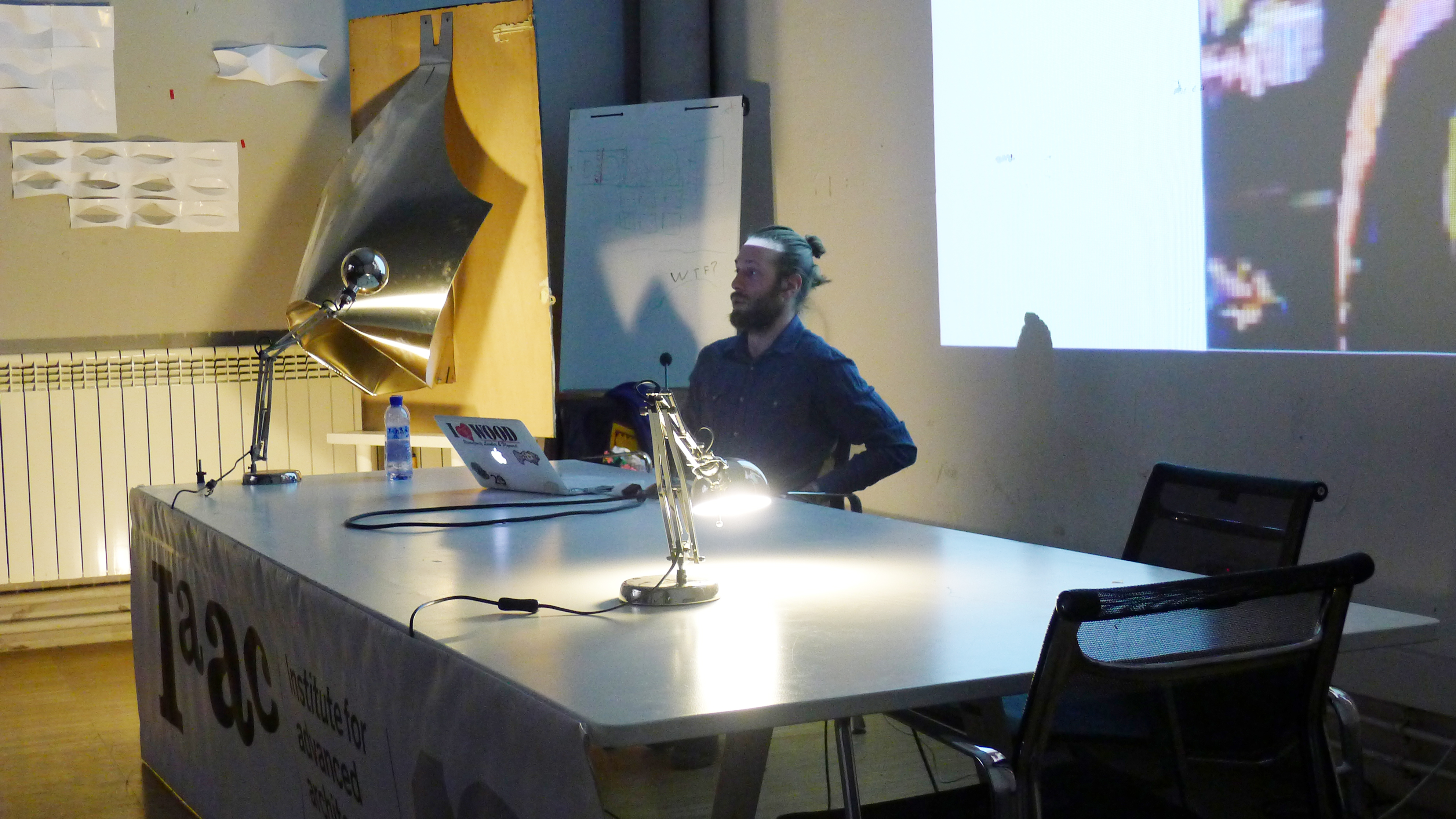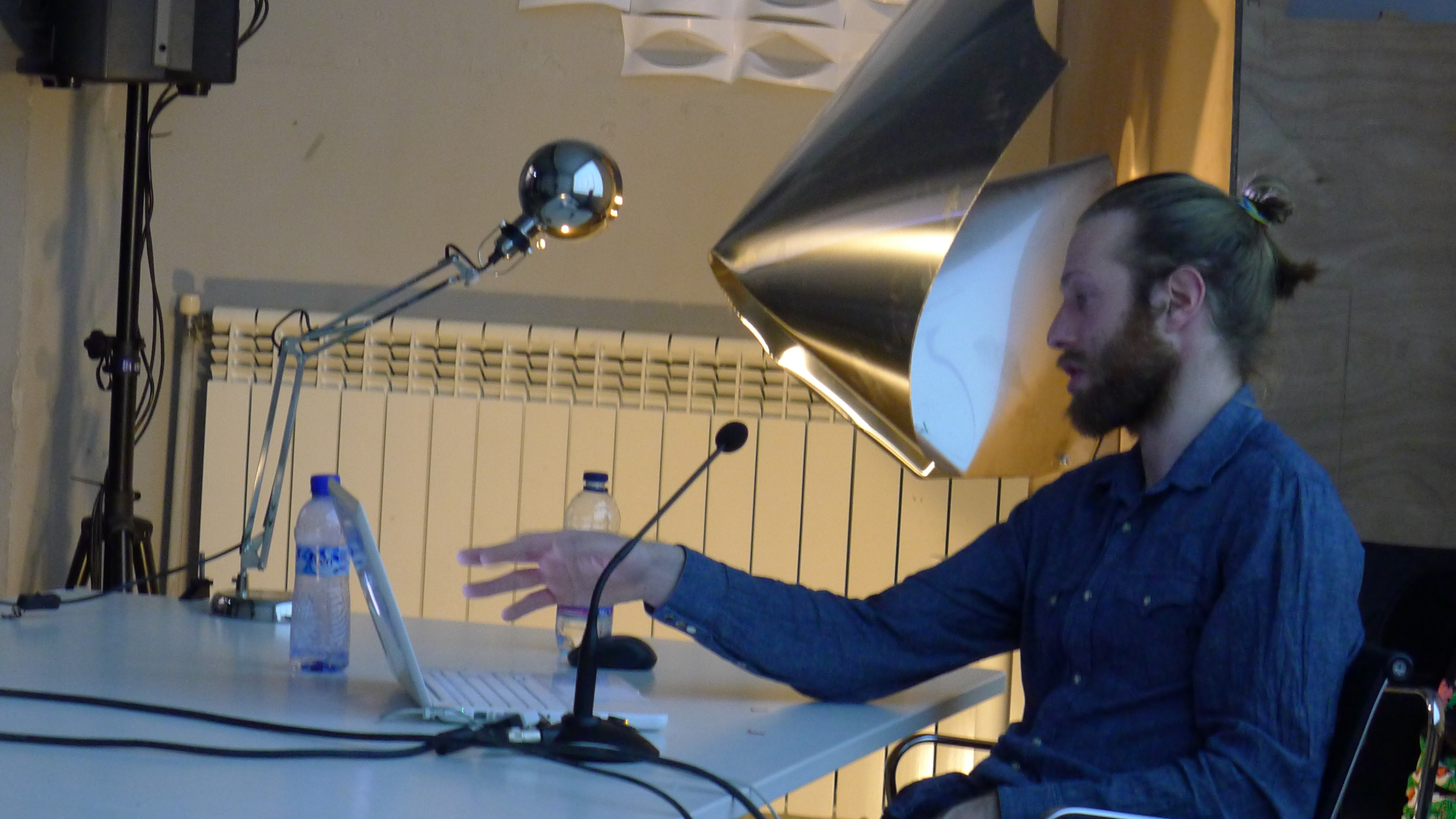
Here are the observations from the device tested on 09 February 2009 between 12:30pm and 2:00pm.

Heating of water in progress - after 30mins of start of the experiment. Note the condensation above the water container.
February 18th, 2009 abhinav.wakhle@iaac.net Posted in Abhinav Wakhle, Yick Ho Alvin Kung | No Comments »
February 10th, 2009 cesar.cazares@iaac.net Posted in Cesar Cruz Cazares, Pablo Rica | No Comments »
Abstract
Vapor 1.0 is a solar driven machine to test and study the steam and condensation effect in different air-filled or vacuumed containers.
Experiment, Aim
The aim of our experiment is to study the effect of steam and its conditions. Our goal is to apply these conditions for creating i.e. a double glass facade in which the steam could work as a light diffuser during day time. Condensation drops on a transparent surface would reflect the evening light and so we would need less electricity for artificial light. At night the facade is clear for the view.
In our experiment we are mainly focusing on water. Other liquids orgases with their effects could further be tested in another experiment.

Above: conceptual 3D sketch of the machine
The machine is operating with distilled water. A parabolic mirror heats up the copper pipe which brings the water inside to boil. The steam is traveling through transparent plastic hoses the the container where the steam cools down and condensate on the surface. The condensed water returns to a second container which feeds the copper pipe.

Above: rhino grasshopper definition was developed to build parabola and focus
We mainly learned from this test the delicate balance the machine must achieve to properly function and also the high connectiveness of all the parts that compose the system. Therefore we believe that little improvements to each component would add up to create a more efficient steam-effect system. Some improvements could involve: reduce the air volume inside the system and length of connecting hoses to reduce cold matter inside the environment; use black supply container and black connecting hoses that would keep water and air warmer inside the system; add a needle perpendicular to the parabolic sun collector to ensure proper orientation (achieved when the needle does not project any shadow).
Including the realization of some improvements to the machine, we would like to carry some more test as the weather gets better in Barcelona to see the machine performing to its maximum capabilities.
Downloads
Full document of the project: vapor1_dossiera4_final.pdf
Rhino Grasshopper parabola definition: parabola-definition.zip
February 10th, 2009 cesar.cazares@iaac.net Posted in Cesar Cruz Cazares, Pablo Rica | No Comments »

Images above from www.greenpowerscience.com and www.bourollec.com
Parabolic Mirror. Captures sun energy at one point an creates an enormous heat source.
Lens. Act like a Parabolic Mirror. Can be point or linear fresnel.
Solar Thermal. Close liquid system that transports heat and translates to another system.
Steam. Water vaporates to steam and steam condences back to water. transparency and opaque effect.
Life Form. Plant, metamorphosis, carbon dioxid, grown.
A closed pipe system captures sun energy and translates the temperature to a second system, which converts steam out of water. With the steam we can construct an open or closed system and use condensation to create an opaque/transparent effect. Life form could be an additive element to increase the desired effect or performance.
February 10th, 2009 shradha.bhandari@iaac.net Posted in Gian Matteo Cossu, Mohamed Omer, Shradha Bhandari | No Comments »
The proposal for a solar reactive skin comes from the study of the non directional nastic movement of plants, the opening/ unfurling of leaves and petals directed by sunlight and rising temperature.
The concept of the module makes use of a heat absorbing pipe network, acting as veins, and using mixture of air and ethanol. This mixture responds to increase in temperature by absorbed solar radiation and expands, unfurling the skin membrane.
Thus the various modules used on a surface would react depending on the Sun’s angle and intensity, providing insulation accordingly.
The action of expansion and retraction of skin is tested on basis of following factors_
Geometry, surface area, cross-section
Coil shape of varying cross sections adapted to enhance thermal absorption and air movement.
Medium
Air+Ethanol
Color
Variations in color of skin membrane
Thermal conductors
Variations in conducting materials and mode of conduction- restrained & unrestrained.
Complete presentation_
February 9th, 2009 ashish.kulkarni@iaac.net Posted in Ashish Kulkarni, Vinay Patil | No Comments »
To test the instrument we took it to the bogatell beach at 12.00 pm on 9th feb 09.
the instrument was setup considering the sun location to gain maximum sunlight through the solar concentrator. the sea water was poured into the 1st chamber. and concentrators were adjusted to maximise the effect.
waiting……….(water to get heated).
after 45 mins the water started condensing on the surface under shade.
February 9th, 2009 tatiana.anagnostara@iaac.net Posted in Maria Koutsari, Tatiana Stelina Anagnostara | No Comments »
February 9th, 2009 ashish.kulkarni@iaac.net Posted in Ashish Kulkarni, Vinay Patil | No Comments »
February 8th, 2009 konstanty.stajniak@iaac.net Posted in Areti Nikolopoulou, Konstanty Stajniak | No Comments »
Artificial - Cloud
Concept:
Creation of rapor effect in the between space that two glasses of window make. The goal was to create some kind of mechanism that would control this rapor effect. So during sunshine we would have fog, this means shadow, but during a cloudy phase of the day we would have clear view through the glasses.
Theoretical background of the proposal is based on:
1. We researched on the optional shape for a static tracker of the sun. In the case of a parabolic reflective surface the rays are reflected towards a specific focal point. If two parabolas are combined a new focial point is created at the intersection of their axis (compound parabola)
Two inward looking parabolas are combined into one component and this is the optimal shape that would give a focal point during more then 3 hours per day.
In order to make this parabolic shape work, we should orientate this section towards E-W axis.
2. Fog made out of dry ice
-Frozen carbon dioxide
-gas we exhale during breathing
-the plants use to photosynthesis
-gas added in water to make soda water
-particularly useful for freezing and keeping things frozen because of its very cold temperature
(-78,5C)
-it is widely used became it is easy to freeze and easy to handle
-dry ice changes directly from solid to gas - in atmospheric condition - without going throught wet liquid stage
-biproduct of the procedure of making ammoniac
-cheap
Description:
The devices is consisted of two parts
1. A passive mechanism, powered by the sun, that will provide liquid water only at sunshine hours. Evaporation - Condensation of water
2. Dry ice that will be used to produce fog through accelerated sublimation
Difficulties:
1. The combination of very cold element (dry ice) and a mechanism that needs high temperatures to work (evaporation of the water)
Solving : Combination of two ways to increase the temperature of the water. Heating the water through direct or reflected radiation (compound parabola) and through isolation of the heated space with isolation and glass to increase the overall temperature.
2. Relation of the modular weight of the fog (produced by dry ice) and the modular weight of the air. Because the first is much (double) as much as the second the mechanism was placed at the upper part of the space to be filled with fog. So when the fog will stop being produced this space will empty of fog.
February 8th, 2009 alejandro.vega@iaac.net Posted in Alejandro Vega Beuvrin | No Comments »
February 8th, 2009 guo.liang@iaac.net Posted in Guo Liang, Qiu Xiao Jian | No Comments »